
Biology
Bachelor of Science
Overview
Since Anton van Leeuwenhoek first observed the microorganism in the 17th century, biology has played a role in some of the greatest discoveries in history. Today, the field is multidimensional, offering promising careers in medicine, ecology, agriculture, sports fitness, genetics, research, biotechnology, and industry, to name a few. The study of life on earth is as varied as life itself.
At Nazareth University, students are mentored by biologists who assist them in the understanding of biology's basic principles, discoveries, and theories. They learn how to develop the habits of a biologist—accurate observation, measurement, and analysis. Students are also encouraged to think independently, and learning becomes less structured as they progress through the program.
All biology majors participate in independent research as a capstone project, and many students do field work and internships. For example, a pre-medical student recently completed an internship in Berlin, Germany working at a center on epilepsy research.
Highlights
- An award-winning faculty, including recent recipients of National Science Foundation grants to study plant growth and to purchase state-of-the-art physiology equipment.
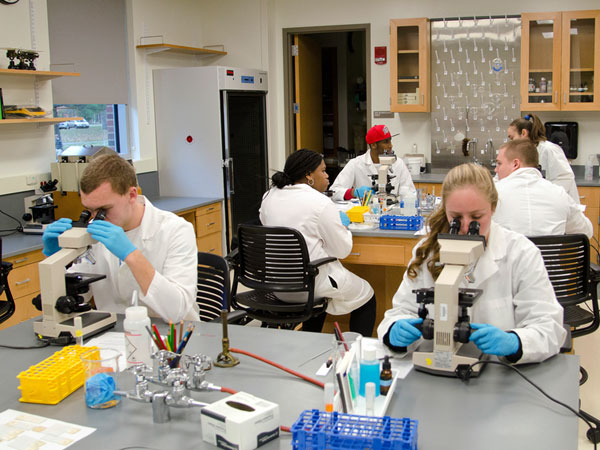
- Great technology at Peckham Hall, including PCR and electrophoretic equipment, digital imaging, and GPS systems. Nazareth's facilities have ranked among the top 20 science labs in the nation, according to The Princeton Review.
- Special community projects and partnerships such as Science Days at the Rochester Museum and Science Center, the Science Olympiad at local schools, internships to study abroad, and the Nazareth University greenhouse.
- Excellent pre-medical, pre-veterinary, and pre-dental programs. Students go on to graduate school, or immediately begin careers in science teaching, laboratory research, or industry.
Partnership with Northeast College of Health Sciences
Students have the opportunity to receive guaranteed admission to Northeast College of Health Sciences (formerly New York Chiropractic College) and a merit scholarship. Learn more »
Program Details
Degree: Bachelor of Science
Related Programs
Fully immersed

Conduct research with faculty during your very first year at Nazareth

Gain hands-on experience with research-grade, state-of-the-art instrumentation

Organize cutting edge research in our three-climate greenhouse and outdoor garden

Work in the lab and in the field to tackle problems in scope from micro to global
Undergraduate Research Topics
- Cell structure and function, both 2D and 3D microscopy
- Bioinformatics
- Toxicology and phytoremediation
- Animal energetics and digestive function
- Stream ecology and GPS
$4,000
UP TO $4,000 TO INVEST IN YOU
Unique to Nazareth, our SPARK Grant provides $1,500 for you to pursue internships, research, and study abroad, plus up to $2,500 in a tuition scholarship for summer SPARK-eligible experiences that earn credit. SPARK stories »


Careers
- Biologist
- M.D., D.V.M., D.D.S., D.O.
- Environmental analyst
- Forensic pathologist
- Geneticist
- Toxicologist
Employers/Graduate schools
- Cornell University’s College of Veterinary Medicine
- Strong Memorial Hospital
- University of Buffalo School of Dental Medicine
- Washington VA Medical Center
Alumni Spotlight
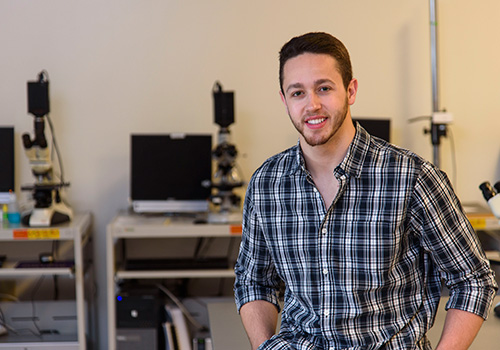
Max Randolph ‘16
Max landed his post-Naz goal: Going to Cornell’s vet school, ranked top in the nation. “I feel very prepared, from my classes and from my experiences,” says Randolph, a biology major with minors in chemistry and pre-veterinary studies. Lab classes capped at 16 students gave him hands-on experiences, even using sophisticated equipment such as a nuclear magnetic resonance spectrometer. His advisor’s encouragement led him to a zoo internship that led to research with a Cornell veterinarian. “Your professors know you and know what you’re interested in.”